
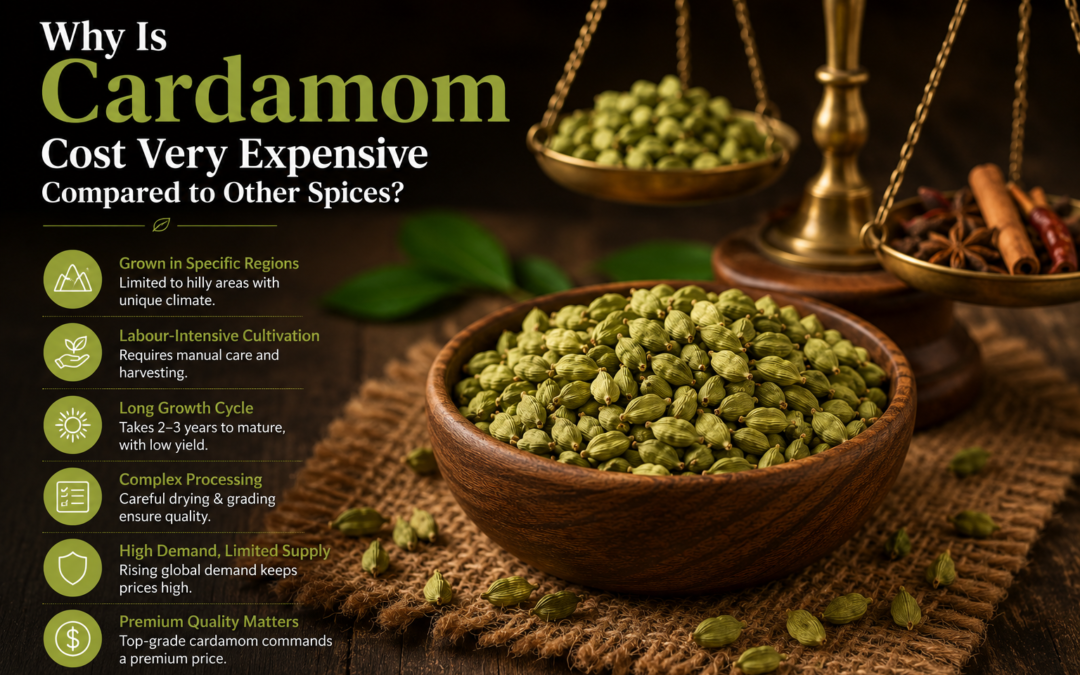
Why is cardamom cost so high? Growing conditions, labour, curing, grading, quality, supply, and demand all influence the final price. Learn what affects cardamom cost and how buyers can choose the right grade from Ritz Brothers
Why Is Cardamom So Expensive?
If you compare different cardamom lots, you will quickly notice that size is not the only factor that matters. Two lots may both be 7mm or 8mm, yet differ in colour, aroma, moisture, filling, cleanliness, and uniformity. These differences can have a direct effect on cardamom cost.
The cardamom cost is built throughout the supply chain. It starts with cultivation and continues through harvesting, curing, cleaning, grading, packaging, transportation, and storage. Supply and demand then influence the final market value.
Cardamom is also a perennial plantation crop. It takes time to establish, and capsules do not mature at the same time. Farmers must return to the plantation repeatedly to harvest mature capsules. This adds labour and production costs that are reflected in the final cardamom cost.
So, there is no single price that applies to every type of cardamom. The right question is not simply, “What is the cardamom cost?” It is, “What grade and quality does this price represent?”
Cardamom Cannot Be Grown Just Anywhere
The cardamom cost begins with the conditions needed to grow the crop.
Small cardamom requires a suitable combination of rainfall, temperature, elevation, soil, moisture, and shade. ICAR–Indian Institute of Spices Research recommends well-distributed rainfall of around 1,500–2,500 mm, temperatures of about 15°C to 35°C, and elevations of roughly 600–1,200 metres above sea level.
Shade management is also important. Cardamom generally grows under filtered light rather than in open, exposed fields. These specific requirements limit where the crop can be grown successfully.
When suitable land and growing conditions are limited, production becomes more specialised. Plantation management, irrigation, crop protection, and labour can all add to the cardamom cost.
RITZ Brothers’ company information states that the business has its own cardamom plantations in Kerala along with a wider sourcing network. This connection to cultivation is valuable because quality starts well before the product reaches the grading stage.
Growing Cardamom Takes Years
Another factor behind the cost of cardamom is time.
Cardamom plants generally begin bearing around two to three years after planting, depending on the planting material and growing conditions. During this period, farmers still need to manage soil, shade, moisture, weeds, pests, diseases, and other plantation requirements.
The grower therefore spends money and labour before receiving a normal commercial return.
Once the plants begin producing, the work continues. Water availability, shade, nutrition, and plant health can all affect yield and quality. Poor growing conditions can reduce both the quantity and quality of the harvest.
Unlike a short-season crop, cardamom ties land and resources into a longer production cycle. This longer cycle is another reason the cardamom cost can be higher than that of some common seasonal spices.
Harvesting Is Labour-Intensive
Harvesting is another major part of the cost of cardamom.
Cardamom capsules do not all mature at once. They are picked at different stages, often at intervals of several weeks. This means workers need to return to the plantation repeatedly throughout the harvesting period.
Timing is important. Immature capsules may produce poorer colour and quality after curing, while overripe capsules can lose desirable green colour or split.
The work is therefore not simply about collecting the largest possible amount. Workers need to identify suitable capsules and handle them carefully.
Repeated harvesting means repeated labour. This adds to production expenses before the crop even reaches the curing stage.
Curing Adds to Cardamom Cost
Freshly harvested cardamom is not ready for commercial sale. The capsules contain high moisture and must be properly cured and dried.
ICAR-IISR describes curing as reducing moisture from around 80% in freshly harvested capsules to approximately 10–12% through controlled drying. Excessive heat can affect colour and may increase the loss of valuable oil from the seeds.
This makes curing a quality-sensitive process.
After drying, the cardamom may also require cleaning, polishing, sieving, sorting, and grading. Each stage requires equipment, labour, time, and quality control.
These activities contribute to the final cardamom cost, but they also turn a freshly harvested crop into a stable and usable commercial product.
Why Cardamom Grades Have Different Prices
One of the biggest reasons for differences in cost of cardamom is grading.
Cardamom is not priced according to size alone. Colour, moisture, aroma, filling, cleanliness, uniformity, and defects can all influence value.
A lot with attractive green colour, good filling, low defects, and consistent pods may command a higher price than a mixed lot of the same approximate size.
For example, an 8mm lot with good colour and uniformity may have a higher cardamom cost than another 8mm lot containing more defective or poorly developed pods.
This is why buyers should always compare like-for-like grades.
Does Pod Size Affect Cardamom Cost?
Yes, pod size can influence the cost of cardamom, but it does not tell the entire quality story.
RITZ Brothers offers 6–7mm, 7–8mm, 8mm+, and custom grades for different B2B requirements. Smaller commercial grades may suit processing applications, while larger and visually attractive pods may be preferred for premium retail and whole-spice applications.
An important point is that the highest grade is not automatically the best choice for every business.
A food manufacturer that grinds cardamom may prioritise aroma, cleanliness, consistency, and value rather than paying extra for oversized pods.
A premium retailer selling whole pods may place greater importance on size and appearance.
Therefore, the right cardamom cost depends on what the buyer actually needs.
How Colour Affects Cardamom Cost
Colour can also influence cost of cardamom, especially when whole pods are sold directly to consumers.
Green cardamom with an attractive and consistent appearance can have stronger commercial appeal. Spices Board quality standards recognise different colour categories, making appearance an important part of commercial grading.
However, colour should not be used alone to judge quality.
A pod may look attractive but have weaker aroma or other quality issues. Buyers should consider colour together with aroma, moisture, pod condition, filling, and uniformity.
For premium applications, this complete assessment gives a better understanding of the true cost of cardamom.
Why Aroma Matters
Cardamom is valued largely for its distinctive aroma.
Its essential oil contains volatile compounds such as 1,8-cineole and α-terpinyl acetate, which contribute to its characteristic fragrance.
Two visually similar lots can therefore perform differently in food and beverage applications if their aromatic quality differs.
For tea manufacturers, bakeries, restaurants, beverage companies, and spice processors, aroma can be an important part of product performance.
This means cost of cardamom is not simply about the appearance of the pod. Buyers are also paying for the quality and performance of the spice.
Does Moisture Affect Cardamom Cost?
Yes. Moisture can influence both quality and cost of cardamom.
Cardamom must be properly dried and stored. Excess moisture can increase storage problems and the risk of mould and deterioration.
At the same time, the curing process must be carefully managed. Poor drying can affect colour, aroma, and overall quality.
For bulk buyers, moisture should therefore be considered when comparing different cardamom lots.
A lower-priced product may not offer better value if its condition creates additional storage or quality problems.
How Weather Affects Cardamom Cost
Weather can influence both production and cost of cardamom.
The crop depends on suitable moisture, temperature, shade, and overall plantation conditions. Extended dry periods can create water stress, while excessive wet conditions can increase disease pressure.
Weather can affect not only the total amount harvested but also the quality mix.
A season may produce enough cardamom overall but fewer premium lots with the size, colour, and uniformity that buyers want.
When supply of a particular grade becomes limited, its cardamom cost can increase.
This is one reason agricultural commodity prices can change over time.
How Supply and Demand Affect Cardamom Cost
Market supply and demand are major factors in cardamom cost.
India has an established small-cardamom auction system through the Spices Board. Lots are offered through e-auctions, where licensed buyers compete based on the available product and market conditions.
Different lots can receive different bids because they vary in quality and grade.
This means there is no single permanent cardamom cost for every product.
Prices can change according to crop arrivals, demand, export requirements, available grades, and buyer competition.
For this reason, a price quoted on one day may not remain the same later.
Why Is Cardamom More Expensive Than Many Common Spices?
The cost of cardamom is higher than that of many common spices because several production challenges occur together.
Cardamom requires a specialised growing environment. The plants take years to begin bearing. Harvesting is repeated rather than completed in one pass. Fresh capsules then need careful curing, drying, cleaning, sorting, and grading.
The final product is also divided into different grades according to characteristics such as size, colour, moisture, and defects.
Other spices have their own production costs, so the comparison is not simply about which crop is harder to grow.
The difference is that cardamom combines a longer plantation cycle, repeated harvesting, specialised processing, and strong grade-based price differences.
All these factors contribute to the cost of cardamom.
Is More Expensive Cardamom Always Better?
No.
A higher cardamom cost may reflect larger pods, better colour, stronger uniformity, lower defects, or limited supply. But that does not mean the most expensive grade is the best option for every buyer.
A premium retail brand may benefit from large, attractive pods.
A bakery or food manufacturer may be more interested in aroma, cleanliness, consistency, and processing value.
The best buying decision is therefore based on application rather than price alone.
A sensible buyer compares the quality offered against the cardamom cost and chooses the grade that provides the best overall value.
What Should Bulk Buyers Consider Before Comparing Prices?
Before comparing the cost of cardamom, buyers should make sure they are comparing similar products.
Look at the grade, pod size, colour, aroma, moisture, filling, defect level, packaging, quantity, and intended application.
For example, comparing a 6–7mm commercial grade with an 8mm+ premium grade only by price per kilogram does not provide a meaningful comparison.
RITZ Brothers offers multiple grades, including 6–7mm, 7–8mm, 8mm+, and custom specifications. This allows businesses to select cardamom according to their product requirements and budget.
The right cardamom cost is therefore the price for the right specification.
Why RITZ Brothers Is a Reliable Cardamom Supplier
RITZ Brothers brings more than 50 years of expertise to the cardamom trade. Its company information highlights premium-quality green cardamom, multiple grades, rich aroma, reliable supply, fresh stock, professional packaging, and bulk availability.
The company also states that it combines its own Kerala plantations with a wider sourcing network.
For commercial buyers, this experience can make sourcing more predictable. Businesses can discuss their required grade, quantity, packaging, and application instead of treating every cardamom lot as the same product.
When evaluating cardamom cost, working with an experienced supplier can help buyers understand exactly what they are paying for.
How to Get Better Value When Buying Cardamom
Getting the lowest cost for cardamom is not always the same as getting the best value.
Instead, buyers should first identify the grade they actually need.
A manufacturer that uses ground cardamom may not need to pay a premium for large whole pods. A retailer selling premium whole cardamom may benefit from investing in better appearance and uniformity.
Buyers should also consider consistency. A slightly cheaper product that varies greatly between batches may create more problems than a reliable product with a predictable specification.
The best approach is to compare quality, grade, freshness, consistency, packaging, supply reliability, and cardamom cost together.
Frequently Asked Questions About Cardamom Cost
Why is cardamom cost so high?
The cost of cardamom is influenced by specialised growing conditions, a long plantation cycle, repeated harvesting, curing, grading, labour, supply, demand, and product quality.
What factors affect cardamom cost?
The main factors include pod size, colour, aroma, moisture, filling, defects, grade, crop availability, processing, demand, and market conditions.
Does bigger cardamom cost more?
Larger pods can have a higher cost, especially when appearance matters. However, size is only one factor. Aroma, colour, uniformity, and defects also affect value.
Why does cardamom cost more than some other spices?
The cost of cardamom reflects its specialised plantation environment, years required before bearing, repeated harvesting, careful curing, and detailed grading process.
Does cardamom grade affect cost?
Yes. Different grades have different specifications and therefore different cardamom cost. Buyers should compare products within the same grade before deciding which quotation offers better value.
Does weather affect cardamom cost?
Yes. Weather can influence crop yield, quality, and the availability of particular grades. Changes in supply can then affect market prices and cost of cardamom.
Is expensive cardamom always better?
Not necessarily. The best product depends on the application. A premium retail business may need a higher grade, while a food manufacturer may prefer a more economical specification.
How can businesses reduce cardamom purchasing costs?
Businesses can reduce unnecessary cardamom cost by selecting the correct grade, buying according to actual consumption, comparing like-for-like products, and working with a reliable supplier.
How does RITZ Brothers help bulk buyers?
RITZ Brothers offers multiple grades, bulk availability, premium-quality green cardamom, professional packaging, and reliable supply. Its company information also highlights more than 50 years of expertise in the cardamom trade.
Final Thoughts on Cardamom Cost
The cost of cardamom is the result of many factors working together. Growing conditions, years of plantation management, repeated harvesting, curing, grading, quality, supply, and demand all contribute to the final price.
The most important lesson for buyers is simple: do not compare cardamom prices without comparing the specifications behind them.
A 6–7mm commercial grade, a 7–8mm grade, and an 8mm+ premium grade are not identical products. Their value depends on their quality and intended use.
For businesses, the best cardamom cost is not necessarily the lowest quotation. It is the price that delivers the right combination of quality, consistency, grade, freshness, and supply reliability.
With more than 50 years of experience and multiple green cardamom grades, RITZ Brothers supports businesses looking for dependable cardamom supply for wholesale, food manufacturing, retail, hospitality, and other commercial applications.
View our process and supply videos and updates on Instagram